Philosophies of landscape often fall into an endless tunnel: “Only this meaning is real; all others are secondary, mistaken, or illusory.”
So, we find painters and poets devoted to “art for art’s sake” on benches, cultural critics passionately discussed questions of identity, power and control in lectural halls, and finally, existential thinkers softly signs “this is dwelling poetically” on gardened grasslands, claiming only ourselves are the subjects of a landscape.
But couldn’t they co-exist? Or, they were just different layers, occuring in different moments of life? An autumn afternnon, gloomy, in Stibbert Park, Florence, those three answers one after the other, unfolded in me for the first time—
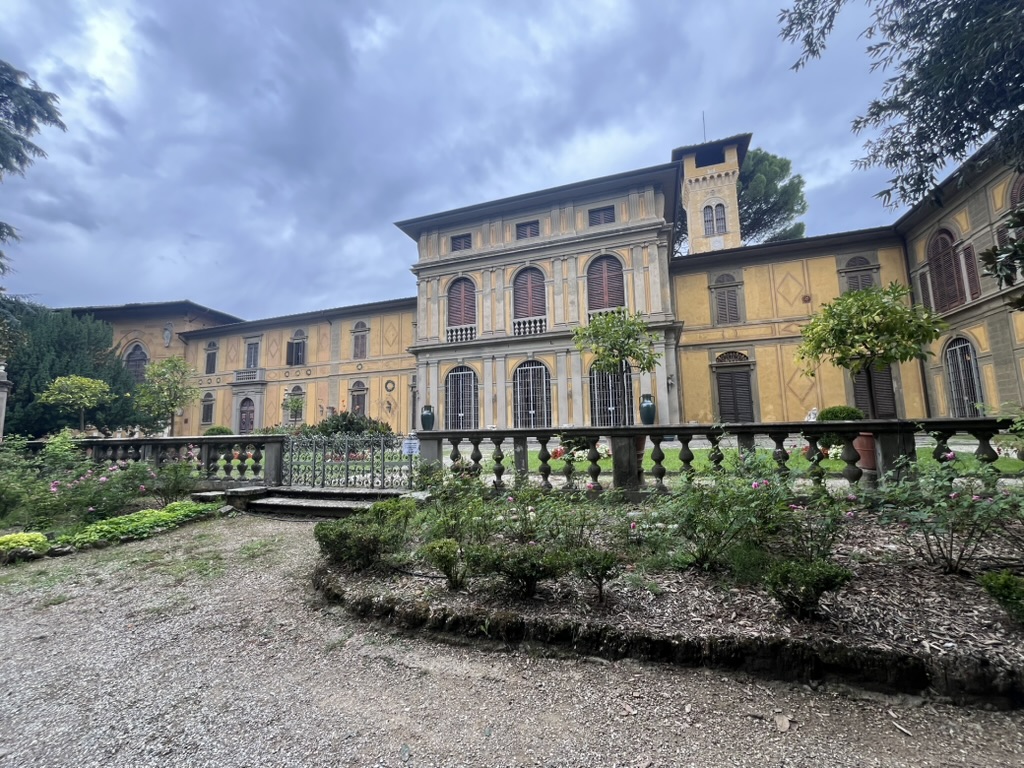
Before knowing anything about the park’s history, I was a painter trying to capture all I could—beneath the dark, brooding clouds, I saw the ochre-toned façade glowed with a gentle warmth. I also found the ornaments and faded frescoes on the walls that, veiled in fog, and appeared through a soft blur, as if time itself had risened them in a haze of mystery. Windows lined quietly before the wall, in strict order, and a nearly perfect proportion in their symmetry. As a painter of realism using words instead of pigments, I named the scene as “landscape” and nicknamed it “beauty”.
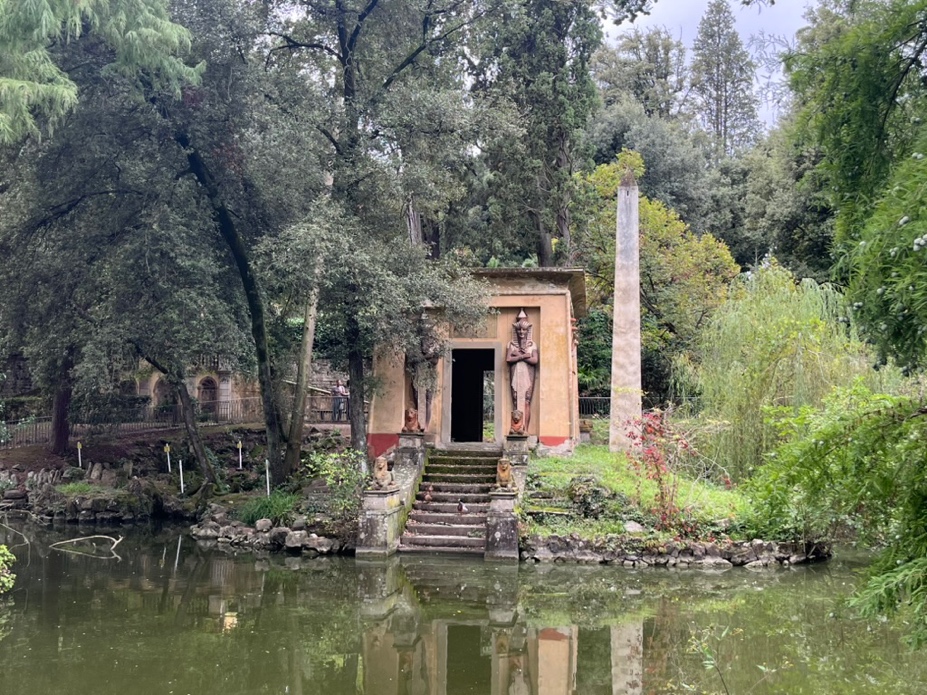

Just as I was preparing to continue seeing with the eyes of a painter, Professor Biagini told us that the park once belonged to Frederick Stibbert, an Anglo-Italian collector and scholar, which reminded me a piece of information from last week’s reading: in the second half of the 19th century, a third of the population of Florence were made up of foriegners, and the majority of them came from Great Britain. I also knew that that was an era of artistic curiosity—art no longer served as the expression of a single civilization, but a fusion shaped by interactions, and ironically, by colonial influences. Perhaps, I should become a cultural critic in the tour, searching for corners that are “Oriental” or “Egyptomanian”, and then, I saw the pond—
In the middle of the pond, there were two sphinx-like figures, undeniably Egyptian. Traditionally, they rose from the arid ground, standing alone in the vast desert as symbols of power and divinity. However, here they seemed closer to us, like dislocated giants who had lost their way home and, in their wandering, became immortals entertaining among ordinary people. Surrounding them was no longer the vast desert, but the simple natural elements often found in London gardens like St. James’s Park—lush greenery, dense trees, crystal-clear water, and in the distance, the cheerful laughter of children celebrating a birthday.
For the two Egyptian friends, is the life in Stibbert Park a happy return to ordinariness, or a misfortune of being descrated? Maybe only themselves could answer it.

I rarely remember the specific scenaries of the parks I’ve visited, but I always remember the people I was talking to during the walks. For me, a park is a place to resonate with my past self—sometimes it feels like déjà vu. People may change, but that quiet sense of being moved remains the same. In a way, memory comes before anything else in a landscape.
Siyu and I were the only Chinese students in the class. Although we didn’t spend much time together in leisure time, she could always remind me to meet her at 10: 15 on G Floor, so we could walk through the path between Natalia and Ulivi, using our most familiar mother language to talk about the complicated feeling of writing poetry in English.
This time in Stibbert Park, we wandered aimlessly, letting the conversation flowed—nothing philosophical, but how our Italian lives were sharply contrasted. While all I praised was about how the three-day weekend had satisfied my craving for sleep, her answer was much richer: she talked about her favorite breakfast restaurant, so delicious it could get her out of bed at 7a.m. and walked 20 mins downhill. She also unhesitatingly poured all the loving words for Venice, recalling the place where each posted photo was taken. As a lazy person who lives 9-to-5 life with minimal elegance, I really appreciate her efforts to make every single day beautiful.
Before we left, she asked me to take a photo of her sitting on a bench. Without thinking, I snapped a quick shot with my phone. She ran over excitedly, glimpsed at the screen, and laughed.
“I’ll teach you how to take it,” she said with a grin.
She instructed me exactly where should I stand, where she, as the model, should be positioned in the photo. I listened carefully to her mini masterclass. After she sat back down, I even hesitated for a few seconds to adjust the angle, aiming for an A+ for this “assignment”.
And then, I took the best photo I’ve ever taken.
She raised a thumb-up, proud of the masterpiece her student had created, quickly airdropped it to me with a sparkle in her eyes, and happily bounced out of the park like a post-meal little rabbit. If I ever look back on Stibbert Park one day, it’ll be a classroom for two—Professor Biagini’s Writing as Exploration, and Professor Sun’s Life as Aesthetic.
 Yiyang Loves Writing